2026 Tax-Free Overtime: How the OBBBA Works
Working extra shifts shouldn't mean losing half your check to taxes. Under Section 70202 of the One Big Beautiful Bill Act (OBBBA), your overtime pay is finally protected from federal income tax — up to $12,500 per year.
The $12,500 Overtime Deduction — Plain English
Starting with the 2026 tax year, the first $12,500 of qualified overtime premium pay you earn is deductible from your federal income tax. This means if you are an hourly worker, healthcare professional, first responder, or tradesperson — you keep more of every "extra" hour you work.
When you earn time-and-a-half ($1.5x), your pay has two parts: the base rate (1.0x) and the premium (0.5x). Only the 0.5x premium is deductible. So if you earn $20/hr regular and $30/hr overtime, only the $10/hr premium qualifies for the tax deduction — not the full $30.
Who Is Eligible?
How to Claim Your 2026 Overtime Savings
Your employer still withholds federal income tax on all overtime during the year — the OBBBA does not change your paycheck withholding. Instead, when you file your 2026 tax return:
- Your employer reports your qualified overtime in W-2 Box 12, Code TT
- You enter that amount on Schedule 1-A of Form 1040
- The deduction reduces your taxable income — preventing overtime from pushing you into a higher bracket
- The result is a larger refund or smaller tax bill when you file in early 2027
Why Standard Tax Tools Don't Calculate This Correctly
Most major paycheck calculators (ADP, SmartAsset, Paycheck City) have not been updated for the OBBBA's "split-income rules." They calculate your overtime using the same bracket as your regular wages — which overstates your tax burden by ignoring the 0.5x premium deduction.
Our 2026 Overtime Calculator applies the correct OBBBA logic: identifying the deductible premium, applying the $12,500 annual cap, and showing your estimated refund separately from your take-home pay — so you see both your actual paycheck AND your year-end savings.
Use the calculator above to enter your hourly rate, overtime hours, and MAGI to see your personalized 2026 overtime tax savings estimate.
How the 2026 No Tax on Overtime Deduction Works
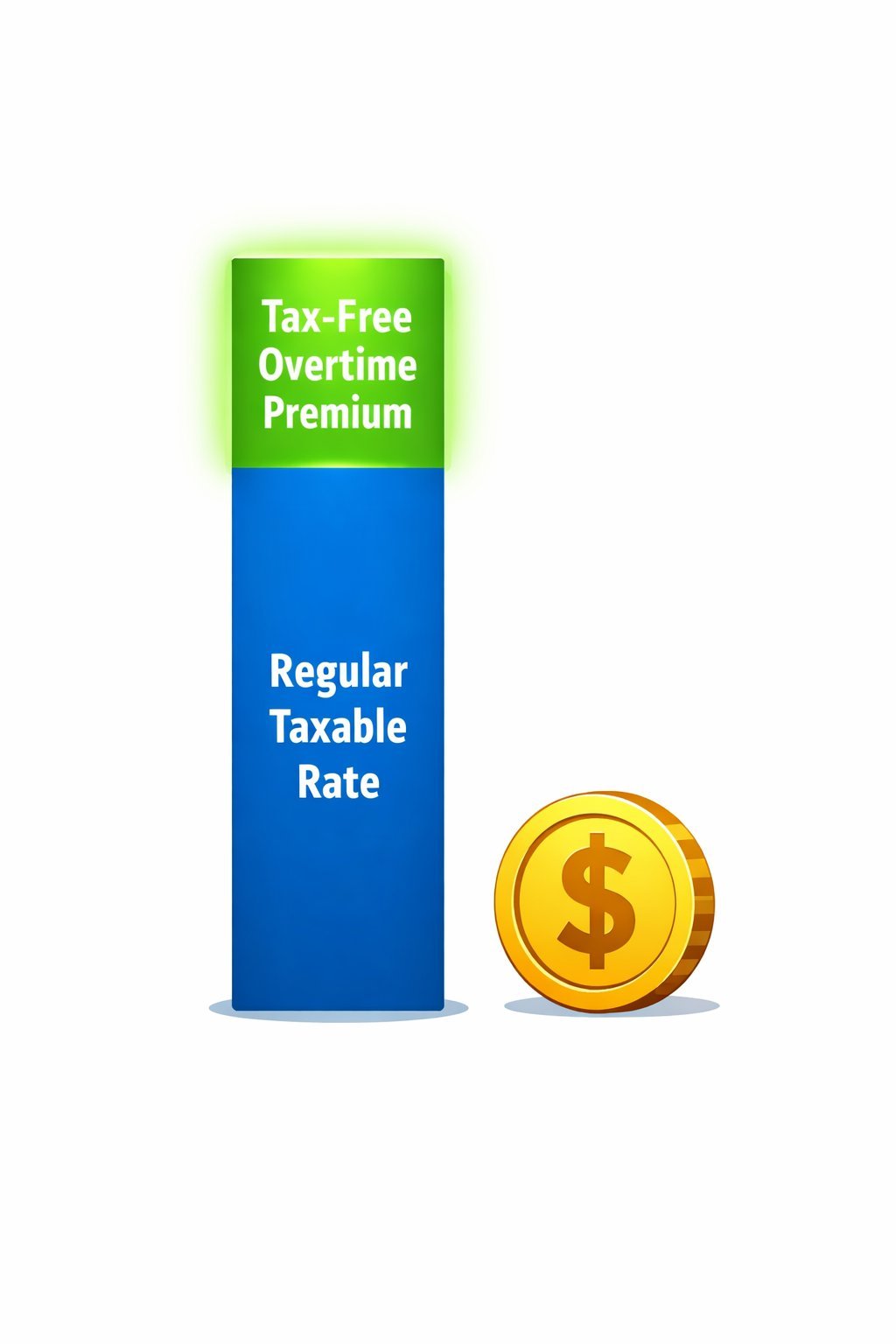
The One Big Beautiful Bill (OBBBA), signed into law July 4, 2026 as Public Law 119-21, created a new federal tax deduction specifically for overtime workers. Under Section 70202, the "overtime premium" — the extra 0.5x portion of your time-and-a-half pay — is now deductible from federal income tax.
The Three-Step Overtime Deduction
The Math: How It Works
If your regular rate is $20/hour and you earn $30/hour for overtime, the deductible premium is $10/hour (the 0.5x portion). The full $30 is still taxed on your paycheck, but at filing time you claim the $10/hour premium as a deduction — effectively getting that portion back as a refund.
2026 Phase-Out Table
| Annual Income (Single MAGI) | Max Overtime Deduction |
|---|---|
| $0 — $150,000 | $12,500 (Full) |
| $160,000 | $11,500 |
| $175,000 | $10,000 |
| $200,000 | $7,500 |
| $237,500 | $3,750 |
| $275,000+ | $0 (Fully Phased Out) |
Married filers: $25,000 max cap, phase-out begins at $300,000 MAGI.
Who Qualifies?
- ✅ W-2 non-exempt hourly employees covered by FLSA
- ✅ Hours worked over 40 in a workweek at 1.5x minimum
- ❌ Exempt salaried employees (executive, administrative, professional roles)
- ❌ 1099 independent contractors and self-employed workers
- ❌ California daily overtime (8-hour rule) unless you also exceed 40 hours/week
Frequently Asked Questions — 2026 Overtime Tax Deduction
Related 2026 Tax Calculators
📚 Sources — Confirmed 2026 Law
- IRS IR-2026-35 — 2026 Tax Year Guidance (OBBB)
- IRS Topic 751 — FICA Rates
- Public Law 119-21 — One Big Beautiful Bill Act, Section 70202
- SSA 2026 Wage Base — $184,500